
Sleep Techniques
Guided Sleep Meditation for Beginners: Your First Night
New to guided sleep meditation? What your first night actually looks like: setup, expectations, troubleshooting, and why drifting off mid-track is success.
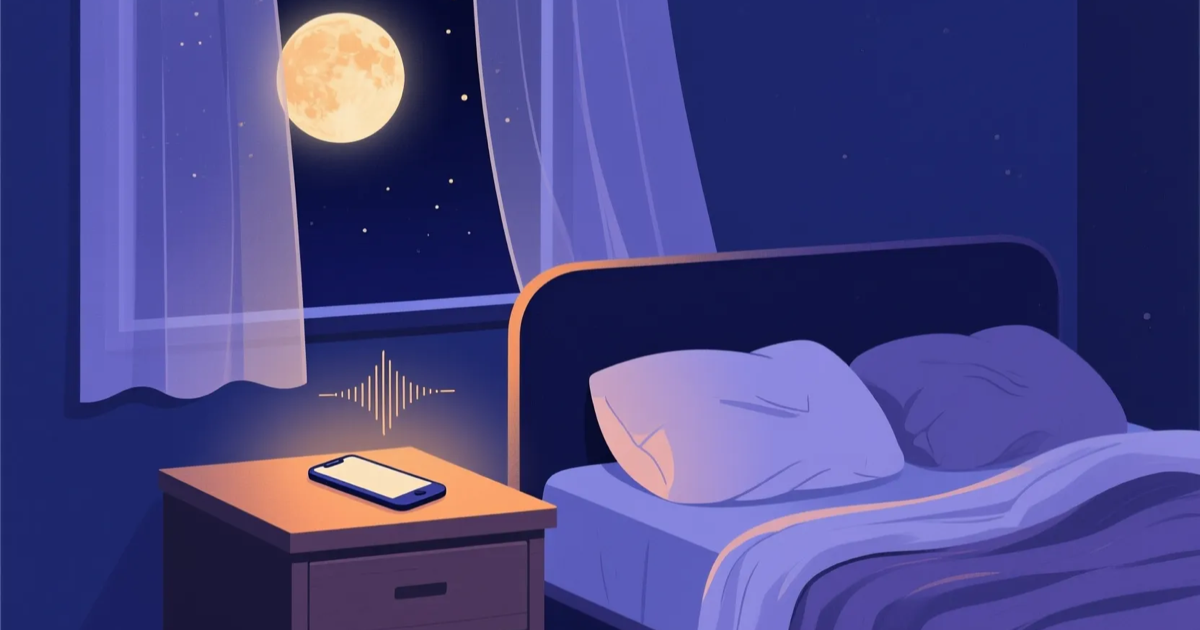
Starting guided sleep meditation takes no experience, no discipline, and no talent for "emptying your mind." Tonight, it takes three things: a short audio track, your normal sleeping position, and permission to fall asleep before the track ends — that last one is the part most beginners get wrong. Pick a session of about 15–20 minutes, set the volume just loud enough to follow, put your phone face-down on the nightstand, and follow the voice. If you drift off somewhere in the middle, that is not a failed attempt. That is the attempt working.
This guide walks through what a first night actually looks like: the five small setup decisions, what to expect once the voice starts, what the research honestly says, and how to handle the four things that usually trip people up in week one.
🧠 What Guided Sleep Meditation Actually Is
A guided sleep meditation is a spoken audio track that leads your attention somewhere calmer than your thoughts. Instead of being told to "relax" and left alone with your worries, a voice walks you through specific steps — slowing your breathing, moving attention through your body, or building a detailed scene in your mind.
That specificity matters. Research on pre-sleep distraction found that people given a concrete imagery task fell asleep faster and had less distressing pre-sleep thinking than people who were merely told to distract themselves (Harvey & Payne, 2002). "Try to relax" gives your mind nothing to hold; "picture the slow sweep of a lighthouse beam across the water" gives it a job.
Two things it is not, for the record:
- It's not emptying your mind. Thoughts will show up — about tomorrow, about that email, about nothing in particular. That's expected, not a malfunction.
- It's not a medical treatment. Guided sleep sessions are wellness and relaxation tools, not therapies for insomnia or any sleep disorder. We'll come back to that honestly in the research section and the FAQ.
🛏️ Setting Up Your First Night: Five Small Decisions
Beginners often assume there's a right way to do this. There are only a few small choices, and none of them are precious:
- Choose a short session — inside 15–20 minutes. Longer isn't better here. The goal is to be asleep before it ends, and a shorter track lowers the pressure to "complete" anything.
- Speaker or earbuds — either is fine. Play it out loud if that's comfortable, or use headphones if you share a room or the speaker isn't positioned well. If you sleep on your side, in-ear buds can press uncomfortably; comfort wins over any theoretical benefit. There's no research saying one is better — this is a comfort decision, not a performance one.
- Volume: just loud enough to follow. Below conversation level. You should have to pay a little attention to hear the voice; if it's cutting through the room, it's too loud.
- Set it up, then put the phone face-down. Choose the session before you get into bed, start it, set the phone down screen-away. Bright light from a screen right at bedtime works against you — e-reader studies have shown evening screen light acutely suppresses melatonin and delays sleep (Chang et al., 2015) — and the general advice holds: keep the last hour before bed quiet and dim (NIH/NHLBI).
- Lie the way you normally sleep. Not sitting cross-legged, not in a "position." The point is to fall asleep, so start from the posture you fall asleep in.
🌙 What the First Night Actually Feels Like
A worked example, because abstract advice is easy to overthink:
It's 11:30 p.m. You've picked a 15-minute body scan, volume low, phone face-down. The voice starts at your forehead and moves slowly downward. About a minute in, you realize you've been thinking about a meeting tomorrow — and you have no idea what the voice has been saying. Fine. You come back to the voice, which is somewhere around your shoulders now, and pick up the thread.
A few minutes later, it happens again, this time about something smaller. You come back again. Then, at some point, you stop registering the words. The track presumably ends; you have no memory of it. In the morning, the gap between "listening" and "waking up" is just — gone.
Three things in that story are normal, and worth naming because beginners often read them as failure:
- Your mind wandered, more than once. Noticing it and coming back to the voice is not the part where you failed — it is the practice. Every time you return, without making a story out of it, that's a successful repetition.
- You didn't hear the end of the track. At bedtime, the session's purpose is to carry you toward sleep, not to be completed. Missing the ending means it worked.
- You kept asking "am I doing this right?" If you're more relaxed than when you pressed play — or asleep — yes. There is no stricter standard.
📚 What the Research Actually Says (Honest Version)
Most articles skip this part, so here it is plainly.
The strongest studies on mindfulness for sleep tested structured, multi-week programs, not a single audio track. In one randomized trial, 49 older adults with moderate sleep disturbances did a six-week mindfulness awareness program and improved more on a standard sleep-quality scale than a comparison group that got sleep-hygiene education (Black et al., 2015). It was a small trial, in older adults, with no long-term follow-up. A separate randomized trial in chronic insomnia found mindfulness-based therapy a promising option worth studying alongside standard care (Ong et al., 2014).
Notice what wasn't tested: pressing play on a recorded session tonight. The studies measured weeks of regular practice with a structured program. A guided track in an app is the home, lightweight version of that — a reasonable everyday stand-in, and the honest way to describe the evidence is encouraging extrapolation, not direct proof.
Two practical takeaways for a beginner, no hype attached:
- Judge by weeks, not nights. The research that exists measured multi-week practice, so a fair trial of guided sleep meditation is a couple of weeks of regular use — not one evening, and certainly not one restless Tuesday.
- Don't expect night one to transform anything. First nights are for learning the shape of the ritual: choosing a session, settling in, letting a voice lead. That's a real first step, just not a finish line.
🔁 Troubleshooting Your First Week
Four things stall almost every beginner. Each has an exit:
"I fall asleep before the track ends." Not a problem — the goal, stated plainly. If this happens every night, you don't need to fix it. You don't need to hear the ending; the ending is for people who are still awake.
"My mind won't stop wandering." It won't, at first — for anyone. Attention returning to a worry is what minds do at bedtime when nothing occupies them. The guided track gives attention a leash; every time you notice you've wandered and come back to the voice, the leash does its job. If wandering is your dominant experience, shorter sessions help, and so does treating each return as the whole point rather than a lapse.
"I don't like the voice / the style / it's boring." Also normal, and fixable by switching rather than quitting. Guided sessions come in different shapes — slow breathing, body scans, progressive relaxation, guided imagery, plain mindfulness — and different pacing and voices. Sampling a few in your first week is part of the process, not indecision. Our overview of guided sleep techniques maps the main types so you can pick your second session deliberately. In Somvia, for instance, the guided library is organized exactly this way — breathing, body scans, imagery, mindfulness — so trying a different shape takes one tap. (If the issue is that you haven't decided between spoken guidance and plain sound at all, that's a different fork: guided sleep meditation vs sleep sounds.)
"I feel more awake, not less." First, shorten the session and lower the volume — over-loud or over-long tracks can hold your attention when what you need is permission to drop it. Second, give it a fair shot on a few different nights before ruling it out. But if you're lying there clearly awake after roughly 20 minutes, stop pushing: get up, keep the lights low, do something quiet, and come back when you're drowsier. That's the standard advice, and our middle-of-the-night playbook walks through it.
❓ Frequently Asked Questions
Do I need any meditation experience to start?
Is it wasted if I fall asleep during the session?
Do I need headphones?
How long until I notice a difference?
Is guided sleep meditation a treatment for insomnia?
Keep Reading



Somvia
Sleep, Guided by Sound
Guided sleep sessions that set the pace for your wind-down and fade as you drift — with steady Sleep Sounds to keep the room quiet underneath.
Learn moreThis article is for general information and is not medical advice. If you regularly struggle to fall or stay asleep, consult a healthcare professional.